What Percentage of Divorced People Marry Again?
Historic period
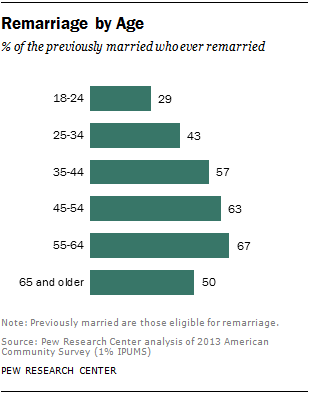 Remarriage is on the rise for Americans ages 55 and older, even as younger generations who have taken the plunge once are becoming less probable to have remarried. What has not inverse is that older adults remain more likely to have remarried than their younger counterparts.
Remarriage more often than not becomes more common with age—not surprising, given that it takes some time to enter into one marriage, exit that marriage and then enter into a subsequent one.7 Merely 29% of previously married adults ages 18 to 24 (absolutely a minor group) had remarried in 2013, compared with 67% of those ages 55 to 64.
But the likelihood of having remarried has dropped sharply for those younger than 35. Among the small-scale group of immature adults who had already exited their first marriage, fully 72% had remarried by 1960. In 2013, only 42% of young adults who had been divorced or widowed had remarried.
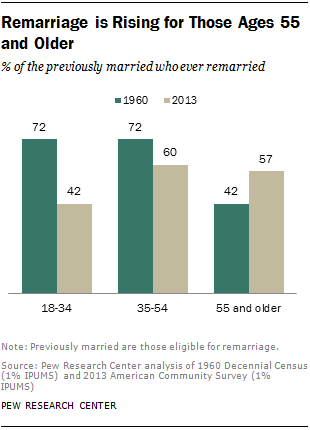 Over that same time period, the share of previously married adults ages 35 to 44 who had remarried dropped essentially (from 76% to 57%), and the share who had remarried among those ages 45 to 54 declined modestly (from 69% to 63%).
The trend in remarriage among adults ages 55 and older has gone in the opposite direction. In 2013, two-thirds (67%) of previously married adults ages 55 to 64 had remarried, up from 55% in 1960. And 50% of adults ages 65 and older had remarried, upwardly from just 34% in 1960. These increases may in function exist fueled past ascent life expectancies. Some advise that longer lifespans have contributed to increasing divorce at older ages every bit people realize they have many more years to live and want to discover fulfillment in that actress fourth dimension. The aforementioned factor may be contributing to increases in remarriage among older adults.8
Gender Gap in Remarriage
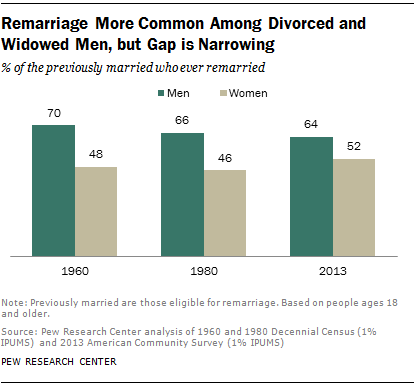 Amongst those eligible to remarry—adults whose beginning union ended in divorce or widowhood—men are much more likely than women to have taken the plunge again. In 2013, some 64% of eligible men had remarried, compared with 52% of women.9
This may reflect, in part, the fact that men who accept been divorced or widowed are more likely to want to remarry than are similarly situated women. Some 29% of eligible men say they want to remarry, and 36% are non sure, according to a recent Pew Enquiry Centre survey; only 30% say they practice not want to marry once again. In contrast, but xv% of previously married women desire to remarry, and 27% are not sure; near half of these women (54%) report that they practice non want to remarry.
While the gender gap in the likelihood to marry again is notable, information technology has narrowed over time, as men have become somewhat less likely to remarry, and women have become somewhat more than likely to do and then. Today's 12-point gap was a xx-point gap in 1980, when 66% of eligible men and 46% of women had remarried. In 1960, the gap was even larger—70% of eligible men had remarried, compared with 48% of women.
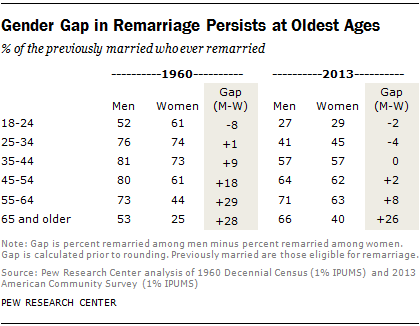 The gender gap has airtight mainly among younger and middle-aged adults who are eligible to remarry. Divorced or widowed women ages 25 to 54 are now about equally likely as men in that age range to take remarried. Among those ages 55 and older, the gap remains substantial.
Looking at educational attainment, the gender gap persists across groups but has narrowed most dramatically amid those with a available's degree. In 1960, among college graduates, merely 40% of divorced or widowed women had remarried, compared with 75% of men. By 2013, that share had risen to 52% among women, but had fallen to 67% among men. In less-educated groups, remarriage among women has remained stable during this time menstruation, while it has declined markedly among men.
Race and Ethnicity
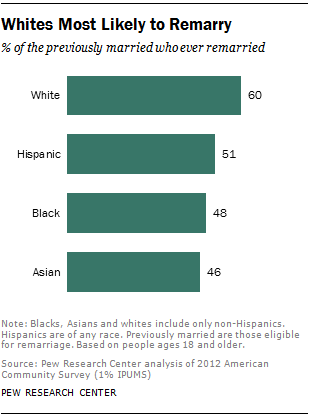 Among adults who accept been divorced or widowed and are thus eligible to remarry, whites are the near likely to have married once more, and this likelihood has increased somewhat in recent decades.10 By contrast, previously married Hispanic, black and Asian adults are less likely to have remarried than in the past. These patterns mirror those seen in rates of kickoff marriage, where whites are more than likely than blacks or Hispanics to enter into spousal relationship for the first time.11
In 2012, six-in-ten whites who had been married before had remarried, compared with 51% of Hispanics, 48% of blacks, and 46% of Asians. Historic period composition is playing a role in these patterns—the fact that whites tend to be older may contribute to their college likelihood of remarriage, for instance. However, some racial and ethnic differences persist, even controlling for age.
Over fourth dimension, the share of previously married whites who remarry has increased somewhat, upwards from 55% in 1960. In contrast, remarriage has declined since 1960 for non-whites and Hispanics. At that time, 63% of blacks, 62% of Hispanics and 49% of Asians had remarried.
The increasing prevalence of remarriage amidst whites is driven entirely by increases among white women. In 1960, 47% of divorced or widowed white women had remarried, and this share rose to 55% by 2012. Past contrast, the share of previously married white men who remarried declined from 69% to 66% over that same time period. For all other racial and indigenous groups, both men and women were less likely remarry in 2012 compared with 1960.
Looking at all currently married adults, one-fourth of whites (26%) and blacks (25%) had been married previously in 2012. This share was lower among married Hispanics (sixteen%) and Asians (ten%).
Birth
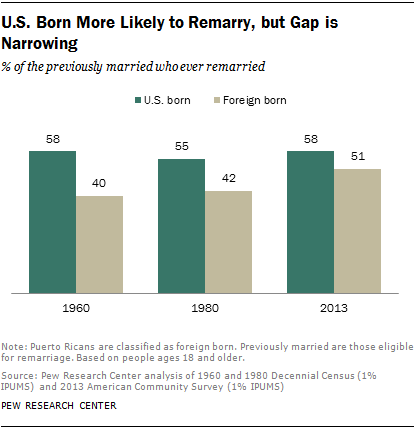 Amidst adults who are eligible to remarry, those born in the U.South. are more likely to do so than those born outside of the U.S., only the gap has narrowed over time equally immigrants take go more than likely to remarry.12 In 2013, 58% of divorced or widowed U.S.-built-in adults had remarried, compared with 51% among the strange built-in. In 1960, those shares were 58% and 40%, respectively, and in 1980, the shares were 55% among the U.South. built-in and 42% amongst the strange born.
Amidst all married adults, about a quarter (26%) of those born in the U.S. are remarried, compared with 14% of foreign-born adults.
Serial Remarriage: Who Has Married Three Times or More?
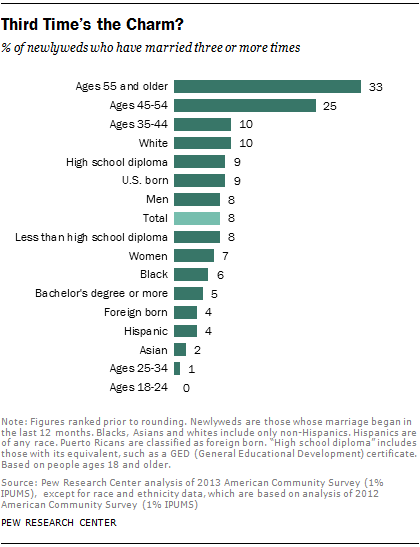 Amid newly married adults in 2013 (those who had wed in the past 12 months), 29% had been married at least once before, and viii% had been married ii or more than times previously. Older newlyweds are amid those nigh likely to exist entering their 3rd marriage. Fully 33% of those ages 55 and older autumn into this category, as do 25% of those ages 45 to 54.
Not surprising, newly married adults younger than 45 were much less likely to be entering into (at least) their tertiary union.
Newlyweds with just a high schoolhouse diploma are most twice equally likely as those with a bachelor'southward caste to be entering their third matrimony (9% vs. v%, respectively). Some 8% of newlyweds without a high school diploma have been married at least twice before.
Ten percent of white newlyweds have been married at to the lowest degree twice earlier, compared with 6% of blacks, four% of Hispanics and just two% of Asians.
Native-born newlyweds are twice as likely equally strange-born newlyweds to be entering a third (or higher order) marriage. 9 percent are doing and then, compared with just 4% amid the foreign built-in.
Source: https://www.pewresearch.org/social-trends/2014/11/14/chapter-2-the-demographics-of-remarriage/

Post a Comment for "What Percentage of Divorced People Marry Again?"